





Evidence-based education studies
Peer-reviewed scholarly journal published quarterly since 2010.
Publisher & Founder
Togliatti State University, Togliatti, Russia
WEB: https://www.tltsu.ru/en
Editor-in-Chief
Mikhail M. Krishtal
Doctor of Physical and Mathematical Sciences, Professor
Scopus ResearcherID ORCID
About
Languages: Russian, English.
Periodicity: quarterly (March 31, June 30, September 30, December 30).
There are no publication fees or fees payable to authors.
The Journal offers authors direct open access to its content.
For the Russian Science Citation Index, full bibliographic description of all papers are indexed and listed in the Scientific Electronic Library eLIBRARY.RU.
Five-year 2024 Russian Science Citation Index Impact Factor is 0.550 (with no self citations).
Before June 2024 - Science Vector of Togliatti State University. Series: Pedagogy, psychology (ISSN Print 2221-5662)
The Subjects for Publishing
The Journal publishes original articles by specialties of “PEDAGOGICAL SCIENCES” and “PSYCHOLOGICAL SCIENCES”. The journal publishes original papers in the following areas:
- General Pedagogy, History of Pedagogy and Education
- Theory and Methodology of Teaching and Education (by areas and levels of education)
- Methodology and Technology of Vocational Education
- General Psychology, Psychology of Personality, History of Psychology
- Labour Psychology, Engineering Psychology, Cognitive Ergonomics
- Developmental Psychology, Acmeology
Current Issue
No 3 (2025)
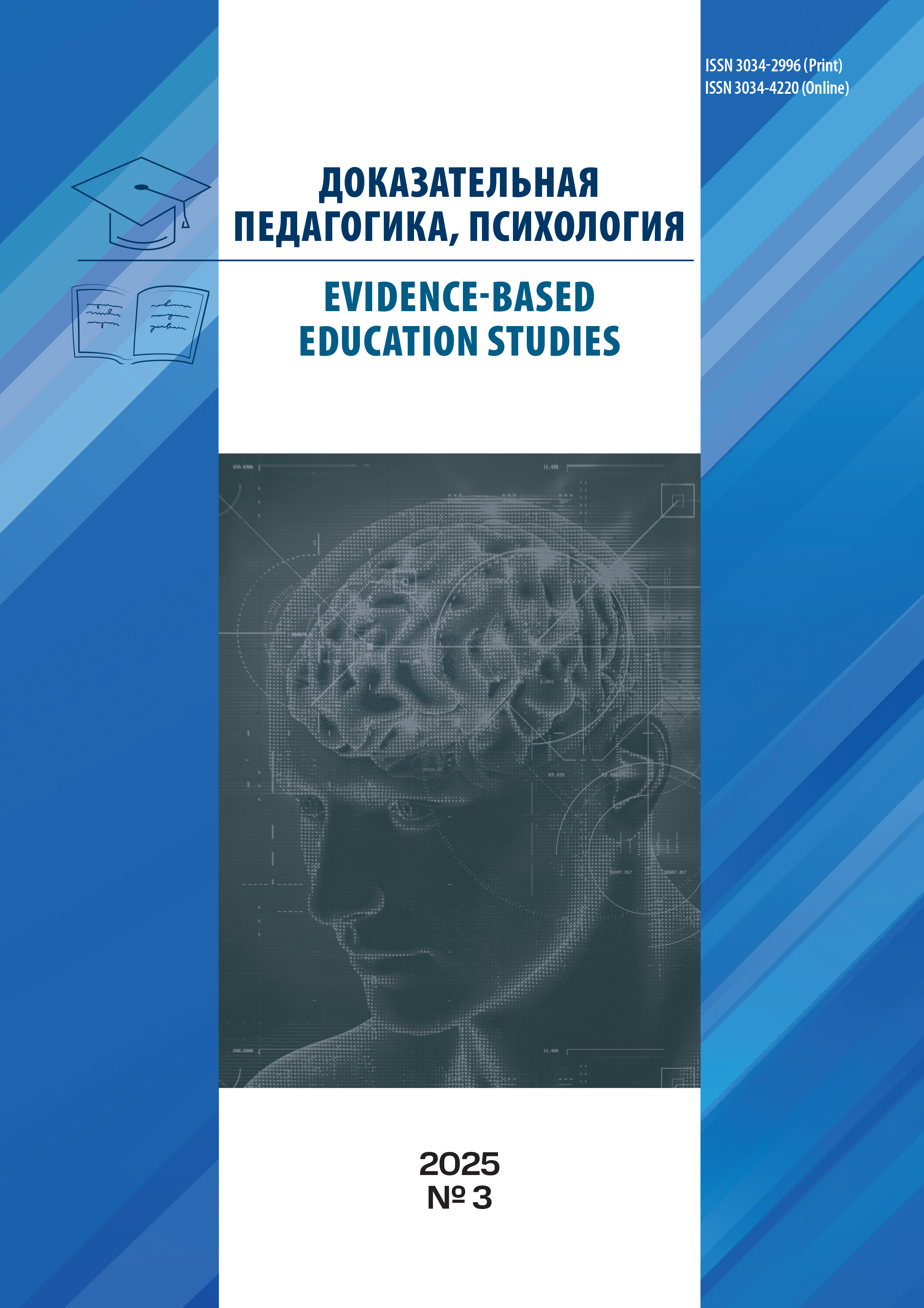
- Year: 2025
- Articles: 4
- URL: https://vektornaukipedagogika.ru/jour/issue/view/50
-
Description:
Published 30.09.2025.

Pedagogical Sciences
Regional model for developing functional literacy in a digital educational environment: concept, implementation, and effectiveness assessment
Abstract
The civilizational transition generates an objective societal need for the development of functional literacy as a key factor for national security and individual success. In response to this need, a dynamic and adaptive model for developing functional literacy is proposed. Its primary advantage is the ability to integrate the relevant regional context and flexibly respond to the challenges of instability and rapid socio-cultural changes. The role of the regional digital educational environment (DEE) in fostering functional literacy among students was examined, using the Samara Region as an example. Monitoring results of students’ functional literacy conducted in 2019 revealed insufficient development of global competencies and creative thinking. To address this issue, the DEE of the region was leveraged to enhance educational quality: students were engaged in project-based activities, their analytical skills were developed, and they were offered contextual tasks simulating real-life situations. Resources of the regional system of supplementary education were actively utilized. Over a four-year period, annual monitoring demonstrated that by 2022, the proportion of students achieving high results increased to 60 % compared to 19.8 % in 2019, representing more than a threefold improvement. These findings indicate the positive potential of using the DEE to create a multifunctional regional educational environment that develops both personal and academic competencies. A key prospect of the study is the transition from episodic monitoring to a continuous formative assessment system based on the DEE, enabling near real-time collection and analysis of educational outcomes at all levels – from individual students to municipalities – for prompt adjustment of the educational process.
 11-23
11-23


Content and technologies of training propagandists for Internal Affairs Agencies
Abstract
Amid the growing destructive influence of social media and the spread of fake news, traditional propaganda methods require re-evaluation and adaptation. The issue of training personnel capable of effectively conducting information and propaganda activities within the Russian Ministry of Internal Affairs has become particularly relevant. The aim of this study was to develop and pilot a professional development programme for Internal Affairs Agencies personnel responsible for propaganda work. A total of 187 participants were involved, including 100 Internal Affairs Agencies officers, 30 active propagandists, and 57 participants in the advanced training course. Data collection methods included questionnaires, the projective technique “Incomplete Sentences”, entrance and exit testing, and the analysis of practical cases. The developed programme comprises five thematic modules designed to develop both theoretical knowledge and practical skills in propaganda activities. Pilot results demonstrated a significant increase in participant competencies: the average post-training test score rose from 9.5 to 13 out of 15 (p<0.001), and the proportion of participants with a high level of preparedness increased from 29.8 % to 84.2 %. Notably, substantial progress was achieved in the identification of fake information (from 39 % to 97 % correct responses) and in conducting counter-propaganda activities (from 47 % to 96 %). These results indicate the high effectiveness of the developed methodology and its potential to enhance the quality of propaganda work within law enforcement agencies.
25-37
Technology for organizing mathematical problem solving using the concept of stage-by-stage development of mental actions and criteria-based assessment when training future mathematics teachers
Abstract
Mathematical knowledge, due to the specific nature of its acquisition through problem solving, plays a special role in the development of various forms of thinking. When solving mathematical problems through the interiorisation of heuristic techniques, a cultural form of creative thinking is formed. The acquisition of analytical heuristics can be influenced by specific methods of organizing the learning process. This paper describes a tool for organizing the teaching of mathematical problem solving as a process aimed at developing guidelines – heuristics – according to the third type of orientation of P.Ya. Galperin’s theory of the stage-by-stage development of mental actions. The paper presents the results of a formative experiment on the acquisition of the proposed framework (the scheme for organizing mental activity, hereinafter referred to as the OMA) by future mathematics teachers while studying the integral calculus of one variable functions. Using the Mann–Whitney U-test, statistically significant differences in the levels of development of the Problem Setting Analysis heuristic were obtained in the control and experimental groups. Due to the small number of groups, a qualitative analysis of the experimental results was conducted. The feasibility of using the OMA framework to implement a strategy of complete acquisition and formative assessment is demonstrated. As it is hypothesized, the systematic use of the OMA framework in teaching to solve problems implements a third-type orientation teaching method and is appropriate for training maths teachers.
39-53
Psychological sciences
Burnout and quality of working life among Russian and Indonesian teachers: a pilot study
Abstract
Innovative changes in education have significantly increased teachers’ workload and stress levels, leading to higher rates of burnout. This burnout adversely affects both their professional performance and personal well-being, highlighting the urgent need to address teachers’ mental health as a key factor in improving educational quality and effectiveness. This pilot study aims to explore the relationship between burnout and quality of working life (QWL) among school teachers in Bangkalan, Indonesia and Vladivostok, Russia, and to compare the levels of burnout and QWL between these two countries. Using a correlational research design, data were collected from a sample of 60 teachers, with 30 participants from Bangkalan, Indonesia and 30 from Vladivostok, Russia. Data analysis included correlation analysis to examine the relationship between burnout and QWL and comparative statistical tests to identify differences between groups. The results indicate a significant negative correlation between burnout and QWL in both countries, demonstrating that increased burnout is associated with a decreased quality of working life. Furthermore, the analysis revealed a significant difference in burnout levels, with Russian teachers experiencing higher burnout than their Indonesian counterparts. However, no statistically significant difference was found in the overall QWL between the two groups. These findings underscore the importance of developing targeted interventions to support teachers’ mental health and improve their working conditions in order to enhance educational outcomes.
57-65